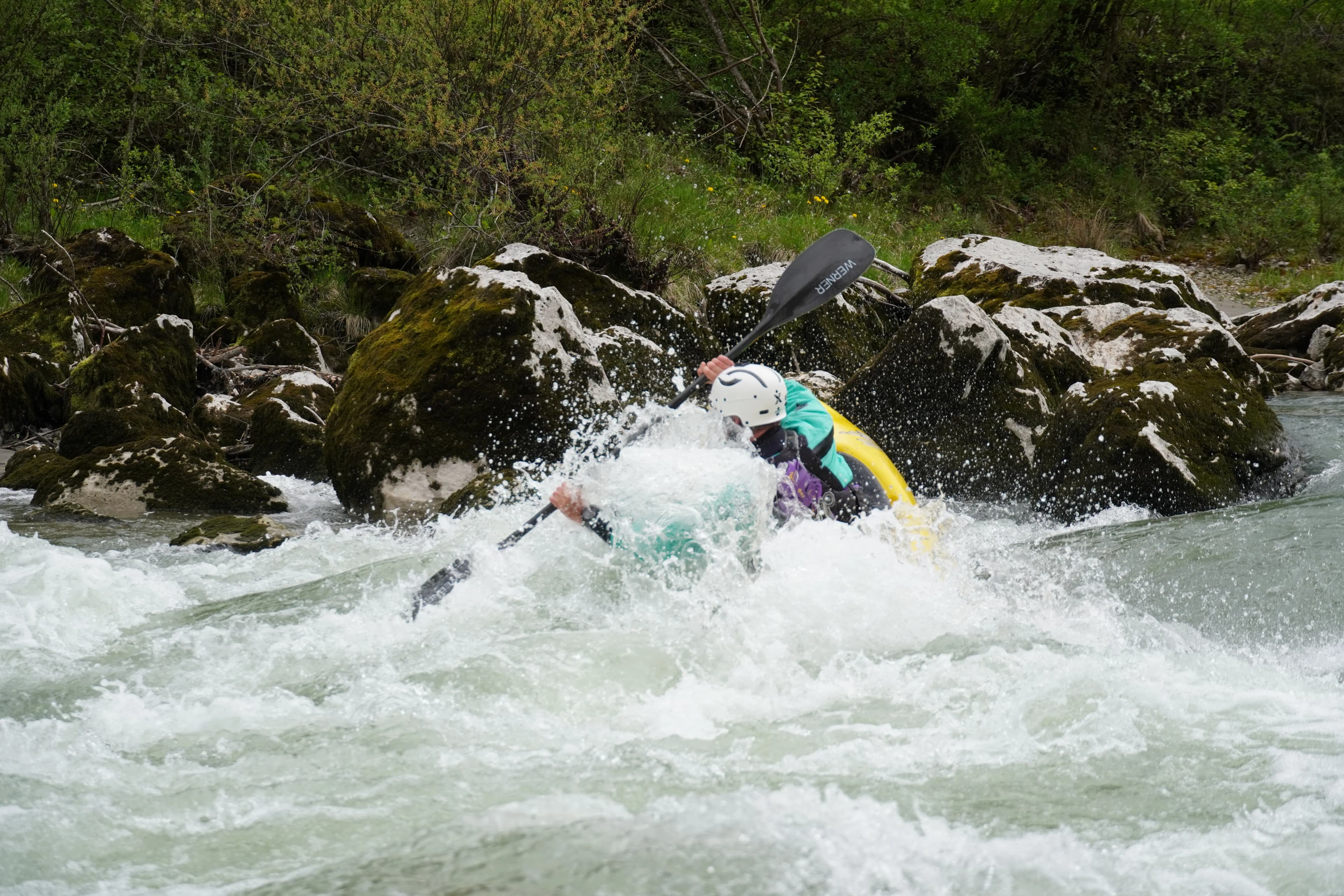
Grade II, Grade III, Grade IV. Everyone talks about river grades, but what do they actually tell you about the water?
The grading system
Whitewater is graded on a scale from I to VI. Grade I is moving water with small waves. Grade VI is the limit of what is runnable. Most recreational paddlers spend their time between Grade II and IV. The system is not perfect and grades can vary depending on water level, but it gives you a rough idea of what to expect.
Grade II: where most people start
Grade II water has straightforward rapids with wide, clear channels. You might need to manoeuvre around some obstacles, but the lines are obvious. This is where you learn the fundamentals: ferry gliding, eddy turns, and basic river reading. The Isar in Bavaria is a textbook Grade II river and it is where a lot of our beginners build their confidence.
Grade III: things get interesting
Grade III has irregular waves, stronger currents, and narrower channels. You need to read the water properly and make decisions about your line. There is less room for error than Grade II, but swims are usually not serious if you know what you are doing. The Salza in Austria has some brilliant Grade III sections that are perfect for pushing into this level.
Grade IV: committing whitewater
Grade IV means powerful, continuous rapids with significant hazards. You need solid boat control, good rescue skills, and the ability to scout and choose your line. This is where coaching really makes a difference because the consequences of poor technique go up.
Why grades are not the full picture
A Grade III at low water is a very different experience from a Grade III in flood. Temperature, remoteness, and how continuous the rapids are all matter. A long Grade II gorge with no easy exit can be more committing than a short Grade III rapid next to a road. This is exactly why we match the river to your level before every session.
Want to put this into practice?
Book a coaching session and we will work on this together on the water.
Get in Touch